A tabletop gaming blog, with a vague bias towards Central/Eastern Europe and the Early Modern period.
Showing posts with label Gaming. Show all posts

Tuesday, August 25, 2020

Gosiewski Rides Out (Pikeman's Lament AAR)

It took a while, but I finally bought a battlemat (from deepcut), set up some tables (uline), and put together a solo Pikeman's Lament game to refamiliarize myself with the system. I even tried to write a narrative battle report, but it was really hard to account for the high number of botched orders.

The terrain is pretty minimal, PL says at least one piece per quarter so I went with that. The forces are PL approximations of a couple of skirmish lists from By Fire and Sword, a game that I doubt I'll ever play but regard highly as a resource.


In particular, the BF&S ruleset has made Wincenty Korwin Gosiewski a minor celebrity among Eastern European Renaissance wargamers, on account of his 1649 raiding party being the only way to field winged hussars in the skirmish level of that game. His Cossack foes for this battle are based on the generic Cossack skirmish force from the same game. For the scenario I went with the basic Ga Pa line-up-and-fight deal, with the Cossacks defending and the Lithuanians attacking.


Cossacks:
2x12 veteran shot (Registered Cossacks)
2x12 shot (moloitsy)
2x12 clubman (peasant rabble)
1x6 commanded shot (plastuny scouts)


Lithuanians:
1x6 veteran gallopers (hussars)
2x6 trotters (rajtars)
2x6 raw gallopers ("cossack-style" light cavalry)
1x6 dragoons

To keep things simple, I made the hussars Veteran Gallopers but not aggressive, both because I didn't want to have to remember the mechanic, and also because I felt that the Gosiewski Party background justified less reckless hussar behavior. I also made no attempt to represent the spearmen mixed in with the Cossack moloitsy, I have a few ideas on how to do so, but didn't want to bother with house rules for this game.

Turn 1: the rajtars and hussars advanced, but the "cossack-style" light cavalry and the dragoons stayed put, a reasonable enough set of results. The actual Cossacks all advanced, save the moloitsy on the side of the village (who were not asked to), and one of the peasant rabbles (fair). The plastuny scouts moved with special elan, accruing a bonus point of honor for their officer on account of their remarkable sneakiness perhaps. First blood to the Cossacks!! Not in-game, but rather, when I was moving one unit of moloitsy, a Cossack in the stationary moloitsy unit stabbed me in the finger with his wire spear, hard enough to draw literal blood. Good for him!


Turn 2 began well enough with the rightmost rajtars advancing, but ended prematurely and absurdly as the hussars decided to flee a half move, apropos of absolutely nothing. The now-exposed rajtar unit prepared for the worst, and while the first salvo from one registered Cossack unit did indeed halve their numbers, the rest of the Cossack army was apparently as confused by the hussars' retreat as the other Lithuanians were....
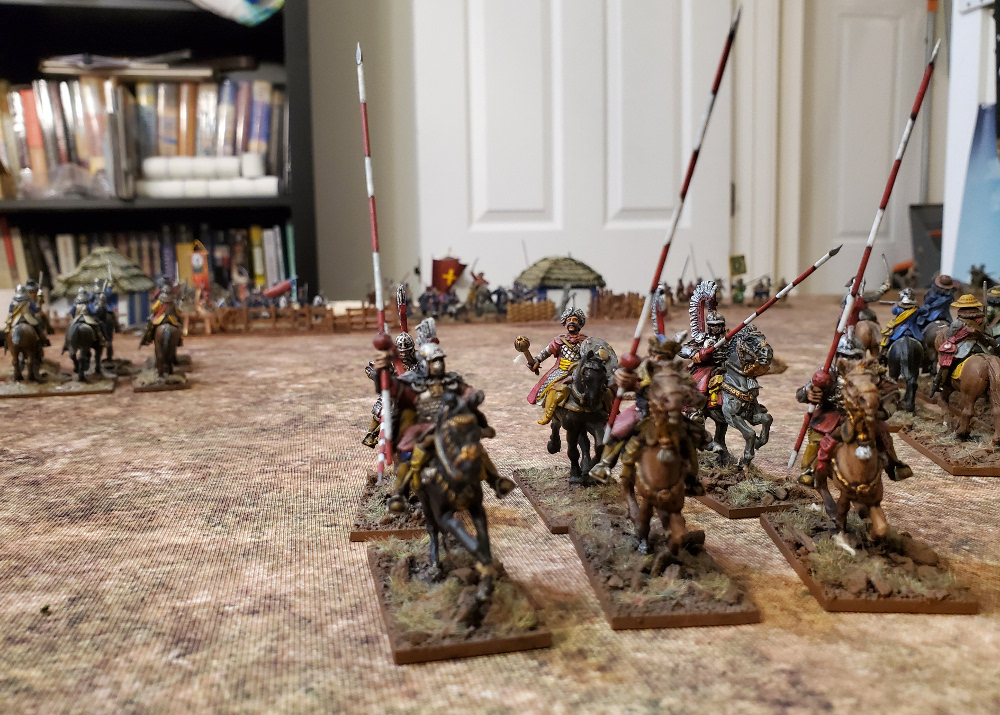


For Turn 3, obviously the priority was to get the elite hussars going back in the right direction (i.e. towards the enemy), but they were unable to move as their commander had to pause to receive a dispatch from high command; unfortunately, his dragoons were being reassigned, effective immediately. Gosiewski's only solace was that his foes remained baffled by his force's shambles, and themselves took no action.

Turn 4 saw the bulk of the Lithuanian force (both light cavalry units and the intact rajtars) finally advance, but a botch on the hussar order saw them become wavering! Perhaps their lances and wings had gotten tangled as they attempted to turn back to face the Cossacks? For their part, registered Cossacks shot down two more rajtars (although the final member of that unit refused to budge), and the other registered unit moved up to the fence, but when the moloitsy outside the fence were ordered to shoot, they decided to advance instead. While it is usually a poor plan for infantry to charge gallopers in this game (or ever), given how poorly the Lithuanians were performing I can't blame the moloitsy for feeling pretty confident.


Turn 5 began with the hussars successfully shaking off their wavering status. This auspicious occurrence was followed by a "successful" caracole from the intact rajtars, that is to say, they received and executed the order, but failed to do any damage to the registered Cossacks opposite them. The remaining cavalry all moved as directed, marking the first turn in the game where an entire force carried out all orders. By way of contrast, the Cossacks failed the first order given.


At the beginning of Turn 6, the hussars advanced for the first time since turn one, though sadly they were unable to charge due to their previous dawdling. Both units of light cavalry, however, were in range to charge, and did! They attacked the out-of-position moloitsy, the first unit dealing some damage before being scattered by the moloitsy's first salvo, the second dealing additional damage and only losing two men in return. Tied for damage, the second light cavalry unit was forced to withdraw (as the attacker), but both units remained in good order. Meanwhile, the intact rajtars performed another ineffectual caracole, while the lone rajtar was unable or unwilling to perform the maneuver.


Turn 6 continued with the registered Cossack units opening fire on the rajtar squadrons nearest them - the lone rajtar was finally gunned down, while the larger unit lost two cavalrymen. Reduction of the Lithuanian force to half strength meant morale testing for every unit, but only the remaining rajtar unit began to waver. The pastuny, who had scaled the hill in such a praiseworthy fashion earlier in the encounter, seemed content to continue posing, choosing to disregard the order to shoot at the nearby light cavalry.


At this point I called it for the Cossacks. While the veteran gallopers are a tough enough bunch that they might well have been able to turn the tide singlehandedly had the game continued, quite frankly I did not want to give them the opportunity after their absurd incompetence throughout the previous turns.

I'm already planning a sort of rematch, with 36ish points per side to more accurately reflect the skirmish lists, more liberal use of special/house rules, and perhaps even a custom scenario to reflect Gosiewski's historical mission.

Sunday, April 1, 2018

Life Changes

When I was a child, I spoke as a child, I understood as a child,
I thought as a child; but when I became a man, I put away childish things.
-1st Corinthians, 13:11


Well.

I had a pretty good run of it, I guess. Played some fun games, did some clever converting and decent painting. Learned some history I might otherwise never have known. Met some cool people.

But the time is no longer right for me to indulge in such hobbies. We must move where life takes us, without clinging to the materialistic diversions that hold us back.

Wednesday, March 7, 2018

First game of Pikeman's Lament

Unfortunately, I was too busy making sure we got the rules more-or-less right to take pictures or put together a proper report. But my opponent managed to get a nice picture at the end of the first turn.


I played the Cossack/Tatar side, and lost pretty handily. Commanded Shot aren't much good out in the open...

Saturday, December 17, 2016

revising my Eastern Europe supplement?

Well, it's been about three and a half years since I put together my Eastern Europe P&S supplement, and it's probably about time to start thinking about a second edition. So far, I've just been brainstorming possible new content. Here's some stuff I'm expecting to include:

  • References to the Devil's Playground terrain/siege rules. (I'm not going to plagiarize anything, but I will direct readers to appropriate pages of that supplement, as some sections are very relevant e.g. Gulay Gorod, Abatis)
  • Rules for Cossack wagons.
  • New and variant unit stats for the main book's Polish and Ottoman armies (e.g. Guard Haiduks, earlier Hussars, Voyniks).
  • Expanded Dramatis Personae listing (e.g. Ivan IV, Maksim Kryvonis, Devlet I Giray, some Radziwill or other...)
  • Historical scenarios
  • At least one battle report
  • And of course, updated illustrations and typo fixes.


Other stuff, possible but not as certain, might include:


  • Fictional Dramatis Personae (e.g. Taras Bulba, Onufry Zagloba, Red Sonya, Baba Yaga, Dracula).
  • Additional army lists (e.g. Late Teutonic Order, 16th-c Hungary, 16th-c Astrakhan, late 16th-c Habsburgs, 17th-c Transylvania)
  • Overall reorganization, i.e. alternating between the potted history and rule/list segments.
  • Modeling/conversion resources.


This new phase of the project is in its infancy right now, but any thoughts or comments would be appreciated nonetheless. Thanks!

Sunday, November 13, 2016

Halloweekend 2016 pics

The weekend before Halloween I had some friends over for a bit of historical/horror Mordheim. Warbands from all over Europe had been pursuing witches and vampires, and all the monsters had converged on a remote Carpathian town for unknown, but presumably dire, purpose. The hunters formed a makeshift alliance, and assaulted the village from all directions to cleanse the evil gathered within.


Saturday, January 23, 2016

Playtesting my rules

Hey, remember that Pike & Shotte supplement I wrote, with lists for Cossacks, Tatars and Muscovites? The fine folks over at Wargame Amateur decided to give them a test run. And even though they only played a couple games so far, they answered one of the biggest questions I had: I was worried that the Gun Shy rule might be too debilitating for Tatars, but apparently that is not the case.

Thanks guys!

Sunday, February 8, 2015

Another test game

The good news is, I played a more complete game than my long-ago first trial run. This one has multiple battalias, some terrain, and a little bit of artillery. Unfortunately, I rolled absolute garbage for both sides' command tests, so the game itself was super lame. That's where there's no proper battle report this time. Just a few of the better pics, and some random thoughts.


I lost my own D6s a while back, so I borrowed the dice from a housemate's Farkel set. This gives me a dozen flag-themed dice per army, with another dozen (green and black) for casualty counts.


My table is only about 3'5" by 5', so I halved all distances (movement, ranges, etc.)


I used my own Cossack list, available here. I guess Wargames, Soldiers & Strategy just published a Cossack list, I'll have to check that out some time.


While I blamed my luck for the dullness of this game, I also could have played better, remembered to use initiative moves, and maybe included some Cossack horse for a more dynamic game. Oh well, live and learn.

Saturday, July 27, 2013

Pike & Shotte Eastern Europe supplement

I put the two army lists together, along with a small Tatar list, and some other bells and whistles, into a PDF available here. I would have posted it directly to the blog, but apparently blogger doesn't support PDFs. grumblegrumble.

Please let me know if you have any feedback at all... from gaming with these lists, or your knowledge of history, or whatever.

Thursday, May 16, 2013

the Gosiewski Challenge


So, to celebrate the imminent success of the By Fire & Sword kickstarter campaign, and inspired by this AAR, I've decided to try to complete a BF&S skirmish group in 28mm. Specifically, the Gosiewski Foray (fourth link from the bottom), which is the only way to field Hussars at the skirmish level.

What makes it a challenge for me? Well, my goal is to try to get this force completed before the BF&S rulebook arrives sometime in June. This picture ought to give a pretty good idea of what I have completed and what I still need to do:


You might notice I'm not really worrying about base size yet. If a read-through of the rules makes it seem really important, I'll put together some movement trays to approximate the BF&S system. Otherwise I'll just fudge it.

And once I've got the rulebook and the Gosiewski Foray, I'll have them fight some Cossacks. Even if I don't end up having 12 points of Zaporozhians by then, BF&S has mechanisms for evening the odds between disproportionate forces. Gosiewski might end up leading his men against a fortified position, or even into an ambush...

Sunday, October 7, 2012

A Skirmish in Volhynia

I finally got around to actually trying out a game of Pike & Shotte. Nothing fancy, just a pretty basic solo game. One battalia per side, no terrain, no skirmishers or artillery or scenario rules.

I don't have a proper gaming table, but I do have a very large bedroom all to myself, so I marked out a 6' by 4' section of the floor to play the game on. The armies consist of everything I have painted and based, except that I held back one unit of German-style musketeers to keep the Polish-Lithuanian army from having more points than the Cossack army. Oh, and one of the Pancerny was actually a medieval Kievan noble.

The Polish-Lithuanian Army was:
Commander, random rating (henceforth, the Magnate)
1x Pancerny squadron
1x Rajtars squadron
1x Haiduks regiment
2x German Musketeers
Total 199 points

The Cossacks had:
Commander, random rating (henceforth, the Hetman)
4x Cossack Infantry (counts as Haiduks)
1x Cossack Pike (counts as Scots Pike from Montrose list)
1x Levy Infantry
Total 214 points

The Cossacks had a bit of a points advantage, but I think that was more than compensated for by their complete lack of cavalry.

The Poles deployed as follows with the haiduks dead center, flanked by German-style musketeers on each side, and then one squadron of cavalry on each wing (the pancerny in the place of honor on the Polish right, the rajtars on the left.) The Polish commander took his place just to the left of the haiduks.


The Cossacks deployment, from left to right, was musketeers - pikemen - musketeers - commander musketeers - levy infantry (peasants) -  musketeers. Note that Cossack musketeers are better in melee than German-style musketeers, and equivalent to haiduks.


Both commanders ended up being rated 8, and the Cossacks won the dice roll to go first. I chose to represent casualties with non-six-sided dice (red if possible), and disorder by positioning the unit leader just outside of the unit, facing inward, as if he is yelling at them to get their act together

Turn 1- The Hetman orders his whole battle-line forward as one... but, as one, they stay in place. Perhaps hungover still?

The Magnate has marginally better luck. Every order he gives is followed, albeit with no particular haste. The infantry lumber forward while the cavalry wings trot around the side of the battlefield in a leisurely attempt at a double-envelopment maneuver.

Turn 2 - Again, the Hetman gives the order for a general advance. Apparently his tone is much firmer this time around, because the whole army positively springs into action, practically sprinting towards their foes. At the end of the advance, the panting Cossacks level their muskets and fire at the Polish forces. The pancerny and the haiduks take casualties, and the haiduks are thrown into disorder by the volley as well.


Startled by the sudden eagerness in his foes, the Magnate immediately orders the pancerny to charge. Unfortunately for him, their distance thwarts his attempts to communicate. Unable to give any more orders, he angrily rides toward the pancerny with the intent to command them in person.

Meanwhile, his infantry fire on the Cossack line, damaging and disordering the Cossack pikemen and the peasant levy, and also causing a casualty on the Cossack unit to the Hetman's immediate right. As the Polish turn ends, the haiduks regain order.

Turn 3 - Extremely concerned by the disruption of his pike formation, and its subsequent inability to repel cavalry until order is re-established, the Hetman makes a risky request of the Cossacks just to his left. They comply aggressively, crossing the battlefield to menace the flank of the worrisome pancerny. In doing so, they draw the attention of the Polish Scots regiment, one of the German-style musketeer units. The Cossacks take traversing fire, which disorders them but causes no casualties.

The Hetman then attempts to order the peasants to charge the other German-style musketeers, but being disordered they are unable to respond.

The two units of Cossack infantry on the Cossack left catch the pancerny in a deadly crossfire. Even with one of the shooting units being disordered, the close range and enfiladed fire ensures that the glittering Polish horsemen are scythed down like ripe wheat. The few survivors scatter.


On the other side of the battlefield, Cossack musketry takes a light toll on the rajtars.

Horrified by the obliteration of his best troops mere moments before he would have arrived to take personal command, the Magnate orders the general attack. The Scots move up to shoot Cossacks at close range, while the Haiduks charge a different unit of Cossacks, and the German musketeers charge the peasants. The haiduks take closing fire, and are disordered but not injured. Finally, he attempts to order the rajtars into the fray, but they prove no less stubborn than the other cavalrymen were. He rides towards them, again intending to take personal command, hoping that this time the squadron will still be there when he gets there...

Despite their prime positioning, the Scots fail to damage the disordered cossacks with shooting.


The haiduks crash into their target, and since both haiduks and Cossacks are capable melee fighters, much violence is anticipated. Alas, it is not to be...only one casualty is inflicted by the haiduks, and none by the Cossacks. It's enough to force a break test though, which the Cossacks proceed to fail. They withdraw one move and become disordered, although the haiduks are unable to exploit the gap on account of their own disorder.

The Germans, despite being mediocre close-combat fighters, do much better, causing two casualties on the peasants for none in return. Flank support from a Cossack unit to the peasants' right is not enough to draw the combat, but apparently the priest leading the peasantry is quite an effective demagogue, because the hapless peasants pass their break test with flying colors.

Turn Four - Anxious to sort out his left flank, the Hetman orders the Cossack pikemen to charge the Scots musketeers. Grateful for the opportunity to actually participate in the battle for once, they get right to it, taking two casualties but no disorder from the closing fire. The Hetman's next concern is the rajtar cavalry loitering on the right. He orders the peasant-supporting cossacks to advance into position to enfilade, but they refuse to abandon their pitchfork-wielding brothers-in-arms.

Every Cossack unit that can shoot, does so, but perhaps they are starting to run low on powder, since no damage is dealt.

Despite the poor showing of musketry, the Hetman is pleased to observe the Cossack pike absolutely steamroll the Scots, destroying them utterly (albeit taking two casualties of their own). Next his attention turns to the German mercenaries battling the poor peasants. When the two sides deal equal damage to each other, the combat is decided by the flank support provided by the stubborn Cossacks. The losing Germans have to test, but suffer no penalty to the roll. Nevertheless, they fail spectacularly and scatter to the four winds.


Having lost three of his five units, the Magnate withdraws from the field and victory goes to the Cossacks.

Thoughts - Well, that was pretty close. If either of the Polish cavalry units had ever got stuck in, things would have gone quite differently. I have to say, this system is pretty easy to get the hang of, but small details can make all the difference. Command distance in particular made life difficult for the Polish commander, on account of his spread-out double envelopment ploy. The Cossack troops, on the other hand, were arranged close enough for battalia orders to be used to good effect.

I look forward to playing again, possibly against a real person some day.