A tabletop gaming blog, with a vague bias towards Central/Eastern Europe and the Early Modern period.
Showing posts with label Terrain. Show all posts

Sunday, January 3, 2021

Crowds of Crossbowmen

I've been able to get a decent amount of painting done over my holiday break, even if I haven't been particularly inspired to blog the past month or so. But here's a bunch of crossbowmen! They are a mix of Warlord and Perry plastics, and Old Glory metals. In Novara the crossbowmen were Gascons and Navarrese, but since they are on the same side as the Landsknechts I let some of them have poofy sleeves for variety. You can also see some of the terrain I've been building from Tabletop Scenics.

Tuesday, August 25, 2020

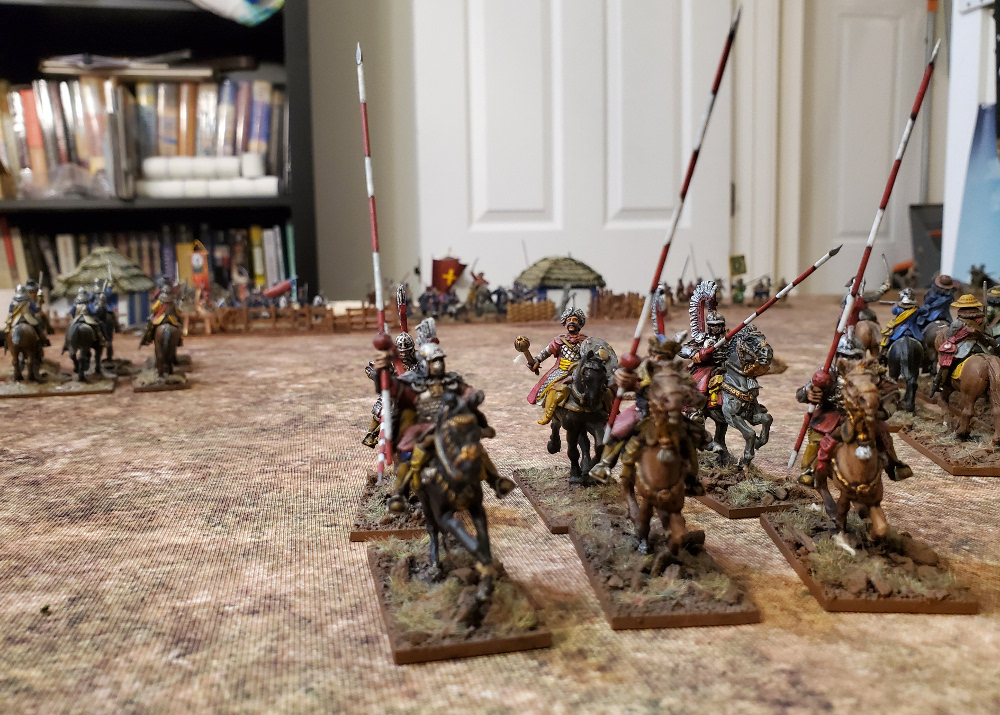
Gosiewski Rides Out (Pikeman's Lament AAR)

It took a while, but I finally bought a battlemat (from deepcut), set up some tables (uline), and put together a solo Pikeman's Lament game to refamiliarize myself with the system. I even tried to write a narrative battle report, but it was really hard to account for the high number of botched orders.

The terrain is pretty minimal, PL says at least one piece per quarter so I went with that. The forces are PL approximations of a couple of skirmish lists from By Fire and Sword, a game that I doubt I'll ever play but regard highly as a resource.


In particular, the BF&S ruleset has made Wincenty Korwin Gosiewski a minor celebrity among Eastern European Renaissance wargamers, on account of his 1649 raiding party being the only way to field winged hussars in the skirmish level of that game. His Cossack foes for this battle are based on the generic Cossack skirmish force from the same game. For the scenario I went with the basic Ga Pa line-up-and-fight deal, with the Cossacks defending and the Lithuanians attacking.


Cossacks:
2x12 veteran shot (Registered Cossacks)
2x12 shot (moloitsy)
2x12 clubman (peasant rabble)
1x6 commanded shot (plastuny scouts)


Lithuanians:
1x6 veteran gallopers (hussars)
2x6 trotters (rajtars)
2x6 raw gallopers ("cossack-style" light cavalry)
1x6 dragoons

To keep things simple, I made the hussars Veteran Gallopers but not aggressive, both because I didn't want to have to remember the mechanic, and also because I felt that the Gosiewski Party background justified less reckless hussar behavior. I also made no attempt to represent the spearmen mixed in with the Cossack moloitsy, I have a few ideas on how to do so, but didn't want to bother with house rules for this game.

Turn 1: the rajtars and hussars advanced, but the "cossack-style" light cavalry and the dragoons stayed put, a reasonable enough set of results. The actual Cossacks all advanced, save the moloitsy on the side of the village (who were not asked to), and one of the peasant rabbles (fair). The plastuny scouts moved with special elan, accruing a bonus point of honor for their officer on account of their remarkable sneakiness perhaps. First blood to the Cossacks!! Not in-game, but rather, when I was moving one unit of moloitsy, a Cossack in the stationary moloitsy unit stabbed me in the finger with his wire spear, hard enough to draw literal blood. Good for him!


Turn 2 began well enough with the rightmost rajtars advancing, but ended prematurely and absurdly as the hussars decided to flee a half move, apropos of absolutely nothing. The now-exposed rajtar unit prepared for the worst, and while the first salvo from one registered Cossack unit did indeed halve their numbers, the rest of the Cossack army was apparently as confused by the hussars' retreat as the other Lithuanians were....


For Turn 3, obviously the priority was to get the elite hussars going back in the right direction (i.e. towards the enemy), but they were unable to move as their commander had to pause to receive a dispatch from high command; unfortunately, his dragoons were being reassigned, effective immediately. Gosiewski's only solace was that his foes remained baffled by his force's shambles, and themselves took no action.

Turn 4 saw the bulk of the Lithuanian force (both light cavalry units and the intact rajtars) finally advance, but a botch on the hussar order saw them become wavering! Perhaps their lances and wings had gotten tangled as they attempted to turn back to face the Cossacks? For their part, registered Cossacks shot down two more rajtars (although the final member of that unit refused to budge), and the other registered unit moved up to the fence, but when the moloitsy outside the fence were ordered to shoot, they decided to advance instead. While it is usually a poor plan for infantry to charge gallopers in this game (or ever), given how poorly the Lithuanians were performing I can't blame the moloitsy for feeling pretty confident.


Turn 5 began with the hussars successfully shaking off their wavering status. This auspicious occurrence was followed by a "successful" caracole from the intact rajtars, that is to say, they received and executed the order, but failed to do any damage to the registered Cossacks opposite them. The remaining cavalry all moved as directed, marking the first turn in the game where an entire force carried out all orders. By way of contrast, the Cossacks failed the first order given.


At the beginning of Turn 6, the hussars advanced for the first time since turn one, though sadly they were unable to charge due to their previous dawdling. Both units of light cavalry, however, were in range to charge, and did! They attacked the out-of-position moloitsy, the first unit dealing some damage before being scattered by the moloitsy's first salvo, the second dealing additional damage and only losing two men in return. Tied for damage, the second light cavalry unit was forced to withdraw (as the attacker), but both units remained in good order. Meanwhile, the intact rajtars performed another ineffectual caracole, while the lone rajtar was unable or unwilling to perform the maneuver.


Turn 6 continued with the registered Cossack units opening fire on the rajtar squadrons nearest them - the lone rajtar was finally gunned down, while the larger unit lost two cavalrymen. Reduction of the Lithuanian force to half strength meant morale testing for every unit, but only the remaining rajtar unit began to waver. The pastuny, who had scaled the hill in such a praiseworthy fashion earlier in the encounter, seemed content to continue posing, choosing to disregard the order to shoot at the nearby light cavalry.


At this point I called it for the Cossacks. While the veteran gallopers are a tough enough bunch that they might well have been able to turn the tide singlehandedly had the game continued, quite frankly I did not want to give them the opportunity after their absurd incompetence throughout the previous turns.

I'm already planning a sort of rematch, with 36ish points per side to more accurately reflect the skirmish lists, more liberal use of special/house rules, and perhaps even a custom scenario to reflect Gosiewski's historical mission.

Friday, January 10, 2020

Trukks and Terrain

In addition to painting the trukks, I've also started to refocus on terrain. I got a foam cutter for Christmas, and since then I've bought a variety of supplies including a grass mat, a sky posterboard, and some trees.


I've also made some walls out of coffee stirrers, small bits of cut foam, and misc. bits. I'm trying to roughly match them to the GW plastic walls I got a while back, and while it's not to hard to see which is which, I'm pleased enough with the overall effect.


Monday, December 31, 2018

an unintentionally morbid end to the year...

Please don't read into this too much. I'm just catching up on some terrain projects, and it just happened to work out that this Reaper Bones piece is my last paint job of 2018.


As you can see, the scale's a little wonky (Reaper is a heroic fantasy line, of course), but whatever. Happy New Year!

Sunday, October 18, 2015

Mordheim Monster Mash

Well, my costume was pretty much finished Friday night, so I needed to find another spooky diversion to last until Halloween. Fortunately, Mordheim is the spookiest, so I wrote up some warbands and brought up a small table and set it up for a quick solo game. Although, to be frank, I don't have enough terrain to really get the proper effect.


These warbands are completely book legal, although some of the other ones that might show up later have been slightly house-ruled to fit my collection.

Pan Blaszkowicz and his men were exploring an abandoned village. Leaving his musketeers and their sergeant in the village, to provide covering fire if needed, he went to investigate the church ruins with his loyal pancerni comrades. But once they left the relative safety of the village walls, the forces of evil attacked.


Sunday, February 8, 2015

Another test game

The good news is, I played a more complete game than my long-ago first trial run. This one has multiple battalias, some terrain, and a little bit of artillery. Unfortunately, I rolled absolute garbage for both sides' command tests, so the game itself was super lame. That's where there's no proper battle report this time. Just a few of the better pics, and some random thoughts.


I lost my own D6s a while back, so I borrowed the dice from a housemate's Farkel set. This gives me a dozen flag-themed dice per army, with another dozen (green and black) for casualty counts.


My table is only about 3'5" by 5', so I halved all distances (movement, ranges, etc.)


I used my own Cossack list, available here. I guess Wargames, Soldiers & Strategy just published a Cossack list, I'll have to check that out some time.


While I blamed my luck for the dullness of this game, I also could have played better, remembered to use initiative moves, and maybe included some Cossack horse for a more dynamic game. Oh well, live and learn.

Saturday, April 21, 2012

Church concept

Inspired by this thread, I'm starting to think about getting a little more ambitious with terrain. So I poked around on Wikipedia's Ukrainian Architecture links until I found this:


My version will probably be plastered/whitewashed, as seems to have been the preferred style in the 1600s, rather than the bare brick pictured above. As an added bonus, this church dates back to about 1200 AD, meaning it could also serve within a Medieval time-frame

I plan to construct it mostly out of Pringles tubes and spare cardboard.

Saturday, April 14, 2012

Little Boxes (a blue one)

And here it is painted. Image is a bit larger than I usually attach, to show the textures. It does suffer a bit from the low-quality towel, but it's rather too late to worry about that.

Thursday, April 12, 2012

Little Box WiP

Here is house number one, in various stages of construction. I started with a piece of corrugated cardboard, folded into a box and reinforced with masking tape. Then I added trim and additional reinforcement made out of coffee stirrers, and the doorframe made out of non-corrugated cardboard.


Then I made the roof frame out of more cardboard (both kinds) and wood.


It's a separate piece, for ease of painting. A view of the bottom shows the (frankly rather rudimentary) structure.


Next step is the thatch. I cut pieces of a spare hand towel into strips and glued them on with overlaps. I wasn't too precise about measurements here, pretty much just eyeballing everything.


I realize the inspiration picture had way more thatching strips than this, but I only have so much patience.


Of course, my guesstimated measurements weren't perfect, but that's ok because I still have the corner bits of thatch to do.


And then here's how the roof looks back on the house. Only missing the watered-down PVA glue on the thatch to give it some weight.


And here's the version with the glue brushed on. Now it just needs paint.


Final note: if you're going to do something like this, consider investing the time/money to get a nice luxurious towel. The fiber loops on this one were pretty threadbare, so the thatch isn't nearly as textured or convincing as it might be.

Sunday, April 8, 2012

Little Boxes (made of ticky-tacky)

So, I've decided to work on terrain. Specifically houses, as you might suspect from the title of this post. I've made thatched-roof cottages before, but they're in storage now. And you can never have too many buildings to fight over, anyhow. Also, I've found better reference pictures this time around.

So, I'm thinking one of these:


And two or three of these:


Should be easy enough to build out of scrap cardboard, wooden coffee stirrers, and bits of towel for the thatch. Throw in a small church, some lengths of fence and maybe a well, and I'll have the makings of a picturesque little Ukrainian hamlet, ready to be devastated by arrogant Poles or rapacious Cossacks.